
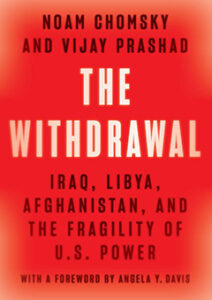
The Withdrawal: Iraq, Libya, Afghanistan, and the Fragility of U.S. Power
$24
“Through the structure of a deeply engaging conversation between two of our most important contemporary public intellectuals, we are urged to defy the inattention of the media to the disastrous damage inflicted in Afghanistan on life, land, and resources in the aftermath of the U.S. withdrawal and the connections to the equally avoidable and unnecessary wars on Iraq and Libya.” —from the foreword by Angela Y. Davis
Not since the last American troops left Vietnam, have we faced such a sudden vacuum in our foreign policy—not only of authority, but also of explanations of what happened, and what the future holds.
Few analysts are better poised to address this moment than Noam Chomsky and Vijay Prashad, intellectuals and critics whose work spans generations and continents. Called “the most widely read voice on foreign policy on the planet” by the New York Times Book Review, Noam Chomsky is the guiding light of dissidents around the world. In The Withdrawal, Chomsky joins with noted scholar Vijay Prashad—who “helps to uncover the shining worlds hidden under official history and dominant media” (Eduardo Galeano)—to get at the roots of this unprecedented time of peril and change.
Chomsky and Prashad interrogate key inflection points in America’s downward spiral: from the disastrous Iraq War to the failed Libyan intervention to the descent into chaos in Afghanistan.
As the final moments of American power in Afghanistan fade from view, this crucial book argues that we must not take our eyes off the wreckage—and that we need, above all, an unsentimental view of the new world we must build together.
Authors
Noam Chomsky
Noam Chomsky, by any measure, has led a most extraordinary life. In one index, he is ranked as the eighth most cited person in history, right up there with Aristotle, Shakespeare, Marx, Plato, and Freud. His contributions to modern linguistics are legendary. In addition to his pioneering work in that field, he has been a leading voice for peace and social justice for many decades. Chris Hedges says he is “America’s greatest intellectual” who “makes the powerful, as well as their liberal apologists, deeply uncomfortable.” The New Statesman calls him “the conscience of the American people.” He is Professor Emeritus in the Department of Linguistics and Philosophy at MIT and Laureate Professor of Linguistics and Haury Chair in the Program in Environment and Social Justice at the University of Arizona. At 97, though having health setbacks, he continues to inform and inspire people all over the world. He is the author of scores of books, including Masters of Mankind, Consequences of Capitalism, Chronicles of Dissent, and Notes on Resistance. He is co-author with Edward Herman of Manufacturing Consent. His latest books are The Myth of American Idealism: How U.S. Foreign Policy Endangers the World and Surviving the 21st Century.
Vijay Prashad
Vijay Prashad is an internationally renowned historian and journalist. He is the executive director of Tricontinental: Institute for Social Research and a correspondent for Globetrotter. He is the author of many books, including The Darker Nations: A People’s History of the Third World and Washington Bullets: CIA, Coups, and Assassinations.
Reviews
There are no reviews yet.