
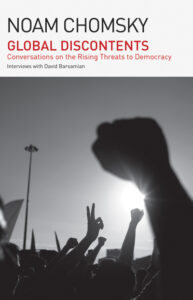
Global Discontents: Conversations on the Rising Threats to Democracy
$20
“If you’ve never read any Chomsky before, and you want to know what all the fuss is about, this book is a good place to start. Yet more evidence of why Chomsky deserves his position as one of the world’s foremost intellectuals.” – The Times Literary Supplement
Global Discontents is a compelling new set of interviews with Noam Chomsky, who identifies the “dry kindling” of discontent around the world that could soon catch fire. In wide-ranging interviews with David Barsamian, his longtime interlocutor, Noam Chomsky asks us to consider “the world we are leaving to our grandchildren”: one imperiled by the escalation of climate change and the growing threat of nuclear war. If the current system is incapable of dealing with these crises, he argues, it’s up to us to radically change it. These ten interviews examine the latest developments around the globe: the devastation of Syria, the reach of state surveillance, growing anger over economic inequality, the place of religion in American political culture, and the bitterly contested 2016 U.S. presidential election. In accompanying personal reflections, Chomsky describes his own intellectual journey and the development of his uncompromising stance as America’s premier dissident intellectual.
Authors
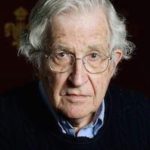
Noam Chomsky
Noam Chomsky, by any measure, has led a most extraordinary life. In one index, he is ranked as the eighth most cited person in history, right up there with Aristotle, Shakespeare, Marx, Plato, and Freud. His contributions to modern linguistics are legendary. In addition to his pioneering work in that field, he has been a leading voice for peace and social justice for many decades. Chris Hedges says he is “America’s greatest intellectual” who “makes the powerful, as well as their liberal apologists, deeply uncomfortable.” The New Statesman calls him “the conscience of the American people.” He is Professor Emeritus in the Department of Linguistics and Philosophy at MIT and Laureate Professor of Linguistics and Haury Chair in the Program in Environment and Social Justice at the University of Arizona. At 97, though having health setbacks, he continues to inform and inspire people all over the world. He is the author of scores of books, including Masters of Mankind, Consequences of Capitalism, Chronicles of Dissent, and Notes on Resistance. He is co-author with Edward Herman of Manufacturing Consent. His latest books are The Myth of American Idealism: How U.S. Foreign Policy Endangers the World and Surviving the 21st Century.
David Barsamian
One of America’s most tireless and wide-ranging investigative journalists, David Barsamian has altered the independent media landscape, both with his weekly radio program, Alternative Radio—airing since 1986— and his books with Noam Chomsky, Eqbal Ahmad, Howard Zinn, Tariq Ali, Richard Wolff, Arundhati Roy and Edward Said. His recent books are Culture and Resistance, Retargeting Iran, Chronicles of Dissent and Notes on Resistance. His latest book is with Arundhati Roy, The Architecture of Modern Empire. David lectures on world affairs, imperialism, capitalism, propaganda, the media and global rebellions.


Muhammad Arslan –
👍🏻
Yasuo –
I’m enjoying reading this new interview collection. Insightful, riveting, and enlightening book. You’re one of the few crown jewel journalists I know who can mine the essence out of Chomsky lode and come it across to an audience.
Glenn –
I couldn’t help to jump to the last section on Trump and friends. Really insightful. Chomsky always has such a fresh and clear way of looking at situations.
Ahron –
Just like power systems a few years back, clear and strong. You gotta love chomsky in this format.
Dan –
Keen commentary on global politics. Commenting on political issues ranging from korean geopolitics to the Trump election and presidency, the book impactfully illustrates Chomsky’s political leanings in a highly literate and structured manner.
Spencer Graves –
Apart from the content, I especially liked the references / endnotes. I have a strong preference for literature that cites its sources: If it seems to conflict with something else I’ve heard, and it has references, I can dig deeper on whatever sounds questionable to me. Without references, I’m stuck.