
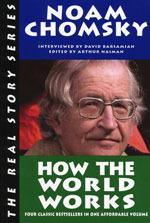
How the World Works
$22
David Barsamian interviews Noam Chomsky
Edited by Arthur Naiman
Soft Skull Press, 2011; 336 pages.
According to The New York Times, Noam Chomsky is “arguably the most important intellectual alive.” But he isn’t easy to read . . . or at least he wasn’t until these books came along. Made up of intensively edited speeches and interviews, they offer something not found anywhere else: pure Chomsky, with every dazzling idea and penetrating insight intact, delivered in clear, accessible, reader-friendly prose.
Published as four short books in the famous Real Story series—What Uncle Sam Really Wants; The Prosperous Few and the Restless Many; Secrets, Lies and Democracy; and The Common Good—they’ve collectively sold almost 600,000 copies.
And they continue to sell year after year after year because Chomsky’s ideas become, if anything, more relevant as time goes by. For example, twenty years ago he pointed out that “in 1970, about 90% of international capital was used for trade and long-term investment—more or less productive things—and 10% for speculation. By 1990, those figures had reversed.” As we know, speculation continued to increase exponentially. We’re paying the price now for not heeding him them.
Authors
David Barsamian
One of America’s most tireless and wide-ranging investigative journalists, David Barsamian has altered the independent media landscape, both with his weekly radio program, Alternative Radio—airing since 1986— and his books with Noam Chomsky, Eqbal Ahmad, Howard Zinn, Tariq Ali, Richard Wolff, Arundhati Roy and Edward Said. His recent books are Culture and Resistance, Retargeting Iran, Chronicles of Dissent and Notes on Resistance. His latest book is with Arundhati Roy, The Architecture of Modern Empire. David lectures on world affairs, imperialism, capitalism, propaganda, the media and global rebellions.
Noam Chomsky
Noam Chomsky, by any measure, has led a most extraordinary life. In one index, he is ranked as the eighth most cited person in history, right up there with Aristotle, Shakespeare, Marx, Plato, and Freud. His contributions to modern linguistics are legendary. In addition to his pioneering work in that field, he has been a leading voice for peace and social justice for many decades. Chris Hedges says he is “America’s greatest intellectual” who “makes the powerful, as well as their liberal apologists, deeply uncomfortable.” The New Statesman calls him “the conscience of the American people.” He is Professor Emeritus in the Department of Linguistics and Philosophy at MIT and Laureate Professor of Linguistics and Haury Chair in the Program in Environment and Social Justice at the University of Arizona. At 97, though having health setbacks, he continues to inform and inspire people all over the world. He is the author of scores of books, including Masters of Mankind, Consequences of Capitalism, Chronicles of Dissent, and Notes on Resistance. He is co-author with Edward Herman of Manufacturing Consent. His latest books are The Myth of American Idealism: How U.S. Foreign Policy Endangers the World and Surviving the 21st Century.

Volmer S do Rêgo –
Perfection would be a superlative. However, it is undoubtedly an excellent work by two of the most important intellectuals and thinkers in the world today. The ability to read and understand the world, to have access to essential languages and their meanings and signifiers, and from this to draw consistent criticism, are part of a constant analytical construction, of deepening the bases of knowledge, with epistemological approaches that include the formation of words (excerpts from systematic etymology – uses and transformations over time) and, consequently, the concepts that arise from them. Such attributes are undoubtedly present in great measure in these two excellent thinkers. They help us greatly to see the world in which we live better (Portugese transalation to English).
Perfeição seria superlativo. Mas, é sem duvidas um excelente trabalho com dois dos mais importantes intelectuais e pensadores do mundo atual. A capacidade de ler e entender o mundo, dispor da linguagens essenciais e seus significados e significantes, e a partir disto abstrair uma crítica consistente, fazem parte de uma construção analítica constante, de aprofundamento nas bases do conhecimento, com corte epistemológicos que incluem desde a formação das palavras (excertos de etimologia sistemática – usos e transformações no tempo) e, por conseguinte, dos conceitos daí expendidos. Tais atributos estão, sem dúvidas, presentes em grande monta nestes dois excelentes pensadores. Eles nos ajudam muito a ver melhor o mundo no qual vivemos.