
Fascism 3-Pack
3 CDs
Includes:
Fascism: The False Revolution
Fascism is being mentioned more and more in the context of U.S. and European elections. It is a term that is bandied about often rather loosely. Orwell wrote that it is understood to be "something not desirable." But it is a complex political and economic synergy that has racism, force and nationalism as its animating matrix. It involves heavy doses of propaganda and media manipulation. Mussolini, in one of his more honest moments said, "Fascism should be more properly called corporatism, since it is the merger of state and corporate power." For Americans it is universally associated with despotic regimes in other countries. It can't happen here. Huey Long, the self-styled populist governor of Louisiana, once warned, "If fascism ever comes to America, it will come wrapped in an American flag."
From Neoliberalism to Neofascism
Fascism of the classic variety is associated with Germany, Italy and Japan. It ends at the conclusion of World War II. But in the recent years there has been the development of a different variety which is neofascism. Neo is a Greek prefix meaning new. From Modi’s India to Erdogan’s Turkey neofascist autocratic regimes have taken hold. There is a direct connection from the failed economic policies of what is called neoliberalism to neofascism. Neoliberalism was given a huge boost in the 1980s by Reagan and Thatcher. Its characteristics are deregulation, cutting government spending, shredding the social safety net, privatization and tax cuts for the rich. The result: widespread immiseration and discontent. In its wake, demagogues exploit the situation. They are coming to power by scapegoating, instigating violence against minorities, coupled with loud calls for "getting our country back," and lots of flag waving.
How Fascism Works
What is fascism? Michael Parenti, author and historian, says, “Fascism historically has been used to secure the interests of large capitalist interests against the demands of popular democracy. Then and now, fascism has made irrational mass appeals in order to secure the rational ends of class domination.” Fascism flourishes in times of economic insecurity and cultural backlash. Opportunistic politicians offer up a platter of racism, xenophobia and hyper-nationalism. They stoke fear and resentment using simplistic slogans such as “Drain the Swamp” and “Build the Wall.” In the U.S. today, there is a whiff of fascism in the air. Witness the march of white supremacists with torches held high in Charlottesville, chanting “Blood and Soil,” an old Nazi slogan and “Jews Will Not Replace Us.” The president called them “very fine people.” Recorded at Trent University.
Speakers
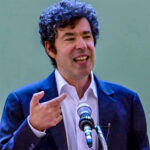
Jason Stanley
Jason Stanley is the Bissell-Heyd Chair in American Studies in the Munk School at the University of Toronto. He is the author of How Propaganda Works, How Fascism Works, and Erasing History.
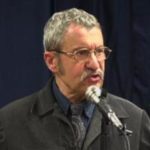
Michael Parenti
Michael Parenti was a leading independent political analyst, scholar, and author. Cornel West called him “a towering prophetic voice.” He taught at major colleges and universities in the U.S. and abroad. He is the author of numerous books, including Democracy for the Few, Power and the Powerless, and Against Empire. He passed away on January 24, 2026, at the age of 92.
Questioning the Unquestionable
“It is not demanded of readers that they embrace my views, but that they reflect upon their own. How seldom we bother to explore in some critical fashion the fundamental preconceptions that shape our understanding of social and political life. How frequently, as if by reflex rather than reflection, we respond to certain cues and incantations, resisting any incongruous notion. Our opinions shelter and support us; it is an excruciating effort to submit them to reappraisal. Yet if we are to maintain some pretense at being rational creatures, we must risk the discomfiture that comes with questioning the unquestionable, and try to transcend our tendencies toward mental confinement.” – Michael Parenti

Prabhat Patnaik
Prabhat Patnaik is an internationally renowned economist. He is a professor emeritus at the Centre for Economic Studies and Planning at Jawaharlal Nehru University in New Delhi. He is the author of Monopoly Capital Then and Now and The October Revolution and the Survival of Capitalism and co-author with his wife, Utsa Patniak, of The Drain of Wealth and Capital and Imperialism: Theory, History, and the Present.




Reviews
There are no reviews yet.