
Democracy 3-Pack
3 CDs
Includes:
Polarization Can Kill Democracy
It’s axiomatic that political discourse in the U.S. is becoming more and more extreme. There’s even talk of a coup. In textbook coups, martial law is declared. The internet and phones go dead. The opposition is jailed or killed. This is how we think of authoritarian regimes beginning. Yet Steven Levitsky says, “Democracies may die at the hands not of generals but of elected leaders.” He lays out a four-part test for identifying authoritarian leaders: rejecting democratic institutions, denying the legitimacy of political opponents, tolerating or encouraging violence and curtailing civil liberties. He notes, “With the exception of Richard Nixon, no major-party presidential candidate met even one of these four criteria over the last century. Donald Trump met all of them.” If we are not careful polarization can kill democracy.
The State of American Democracy
There’s a new Jim Crow in the U.S. This 2.0 version is legislation passed by politicians who mouth pieties about protecting our sacred right to vote and the integrity of elections. After one of the most secure and verified elections in U.S. history there is a wave of voter suppression laws being proposed across the country. According to the Brennan Center for Justice, Republican legislators in 43 states have introduced more than 250 bills that would make it harder to vote. These measures primarily seek to impose stricter voter ID requirements, reduce the number of polling places, limit mail drop boxes and early voting. These actions are an open assault on the 1965 Voting Rights Act that Dr. King, John Lewis and so many others fought for. What’s going on with American democracy?
Capitalism
Discussions about democracy probably started in Athens about 2500 years ago. A truism is that society is democratic to the extent that its citizens play a meaningful role in managing public affairs. Democracy is located within the capitalist economic system, infamous for producing colossal inequality. There's no level playing field, as great income and wealth translate into political power for the haves at the expense of the have-nots. We have procedural democracy: elections, broadcast debates, primaries, etc. Citizens are largely marginalized, overwhelmed by big money and powerful lobbies. Look at the widespread demand to ban assault weapons of war, for universal single-payer health care, to protect the environment, and for affordable housing. People want those things but elites have a simple message. Vote. Then go home and leave everything to us. Actual democracy is hollowed out. A Davos-type class rules. Recorded at the University of Colorado.
Speakers
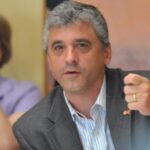
Steven Levitsky
Steven Levitsky is a Professor of Government at Harvard. His research interests focus on Latin America and include political parties, authoritarianism and democratization, and weak and informal institutions. He is co-author of How Democracies Die and Tyranny of the Minority.
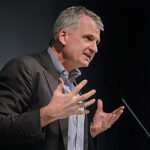
Timothy Snyder
Timothy Snyder is an award-winning professor and historian of European history at the Munk School of Global Affairs and Public Policy at the University of Toronto. Before Toronto, he taught at Yale for more than twenty years. He is the author of Black Earth: The Holocaust as History and Warning, Our Malady, and On Tyranny.
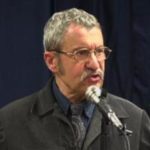
Michael Parenti
Michael Parenti was a leading independent political analyst, scholar, and author. Cornel West called him “a towering prophetic voice.” He taught at major colleges and universities in the U.S. and abroad. He is the author of numerous books, including Democracy for the Few, Power and the Powerless, and Against Empire. He passed away on January 24, 2026, at the age of 92.
Questioning the Unquestionable
“It is not demanded of readers that they embrace my views, but that they reflect upon their own. How seldom we bother to explore in some critical fashion the fundamental preconceptions that shape our understanding of social and political life. How frequently, as if by reflex rather than reflection, we respond to certain cues and incantations, resisting any incongruous notion. Our opinions shelter and support us; it is an excruciating effort to submit them to reappraisal. Yet if we are to maintain some pretense at being rational creatures, we must risk the discomfiture that comes with questioning the unquestionable, and try to transcend our tendencies toward mental confinement.” – Michael Parenti

Reviews
There are no reviews yet.